
AI Shopping Assistant vs. Product Recommendation Engine. What’s the Difference?

One watches what shoppers click. The other asks what they need.
That difference sounds small. It decides whether a first-time visitor, someone you know nothing about, leaves with the right product or just leaves. Both tools promise “AI-powered recommendations”, so it’s easy to assume they’re interchangeable. They’re not, and choosing the wrong one for the job leaves money on the table.
Quick answer: A product recommendation engine suggests products automatically based on behavioral data such as browsing history, purchases and what similar shoppers bought. An AI shopping assistant asks shoppers about their needs, in a guided flow or conversation, and recommends products based on their answers. Recommendation engines work best for returning shoppers with history; AI shopping assistants work from the first visit because they don’t need prior data.
Key takeaways
- Recommendation engines infer intent from behavior; AI shopping assistants ask for it directly.
- Assistants solve the “cold-start” problem: they work for anonymous, first-time visitors.
- The strongest setups combine both, with assistant answers making the engine smarter.
What is a product recommendation engine?
A product recommendation engine is software that automatically suggests products to shoppers based on data about their behavior and the behavior of similar shoppers. It powers the familiar “Customers also bought”, “You may also like” and “Recommended for you” widgets.
Most engines use one or more of these methods:
- Collaborative filtering: “Shoppers who bought X also bought Y.”
- Content-based filtering: recommends items with attributes similar to what the shopper viewed.
- Popularity and trending: bestsellers, most viewed, trending now.
- Behavioral personalization: ranks products using the shopper’s own clicks, carts and purchases.
Recommendation engines are excellent at scale. Once they have enough data, they quietly lift cross-sells and repeat purchases with no effort from the shopper. Their weakness is the cold-start problem: with a new visitor, or a new product, there’s little or no data to learn from, so the engine falls back to generic bestsellers.
What is an AI shopping assistant?
An AI shopping assistant is software that helps shoppers choose products by asking about their needs and recommending matches, the way a knowledgeable store associate would. It may take the form of a guided product finder, a product recommendation quiz or a conversational chat interface.
Instead of inferring intent, it collects it:
- “What will you mainly use the laptop for?”
- “How important is battery life to you?”
- “What’s your budget?”
AI makes these assistants faster to build and smarter to use. It can draft questions from your catalog, understand free-text answers and explain in plain language why each product fits. Because the assistant starts from the shopper’s own words, it works from the very first visit, with no history required.
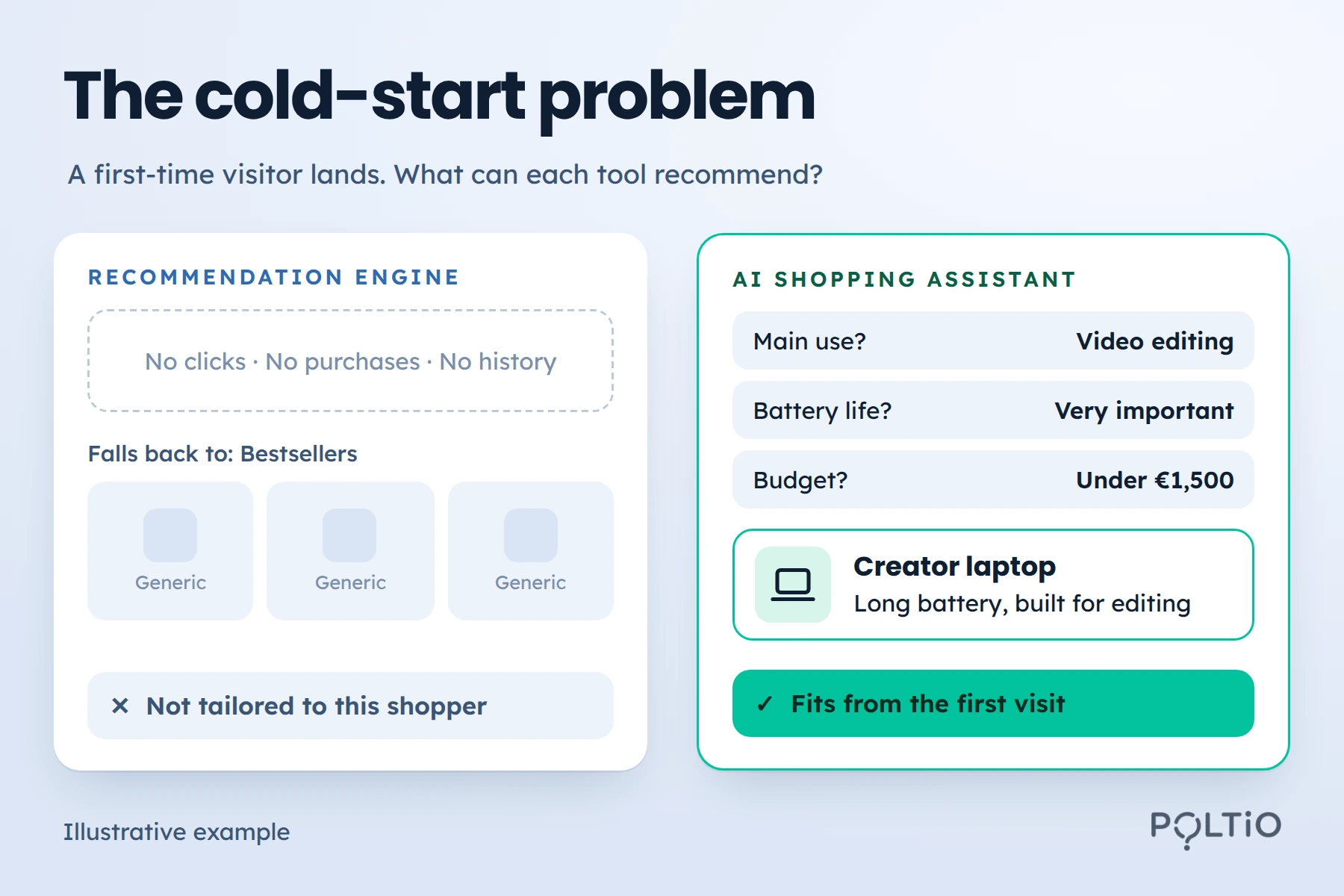
Every answer is also zero-party data: information the shopper chose to share, which you can reuse (with consent) across email, ads and your recommendation engine.
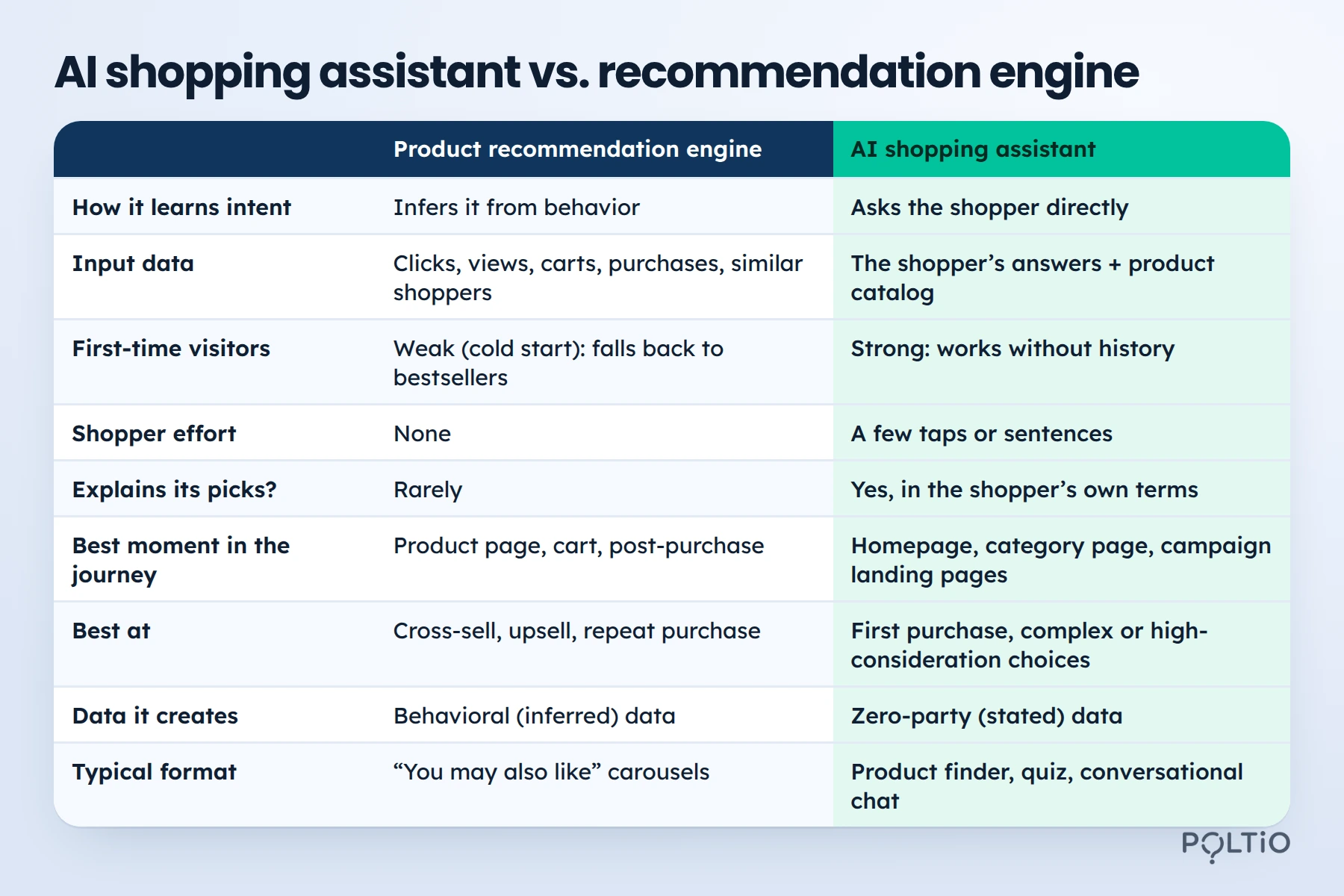
AI shopping assistant vs. recommendation engine: side by side
When do you need each one?
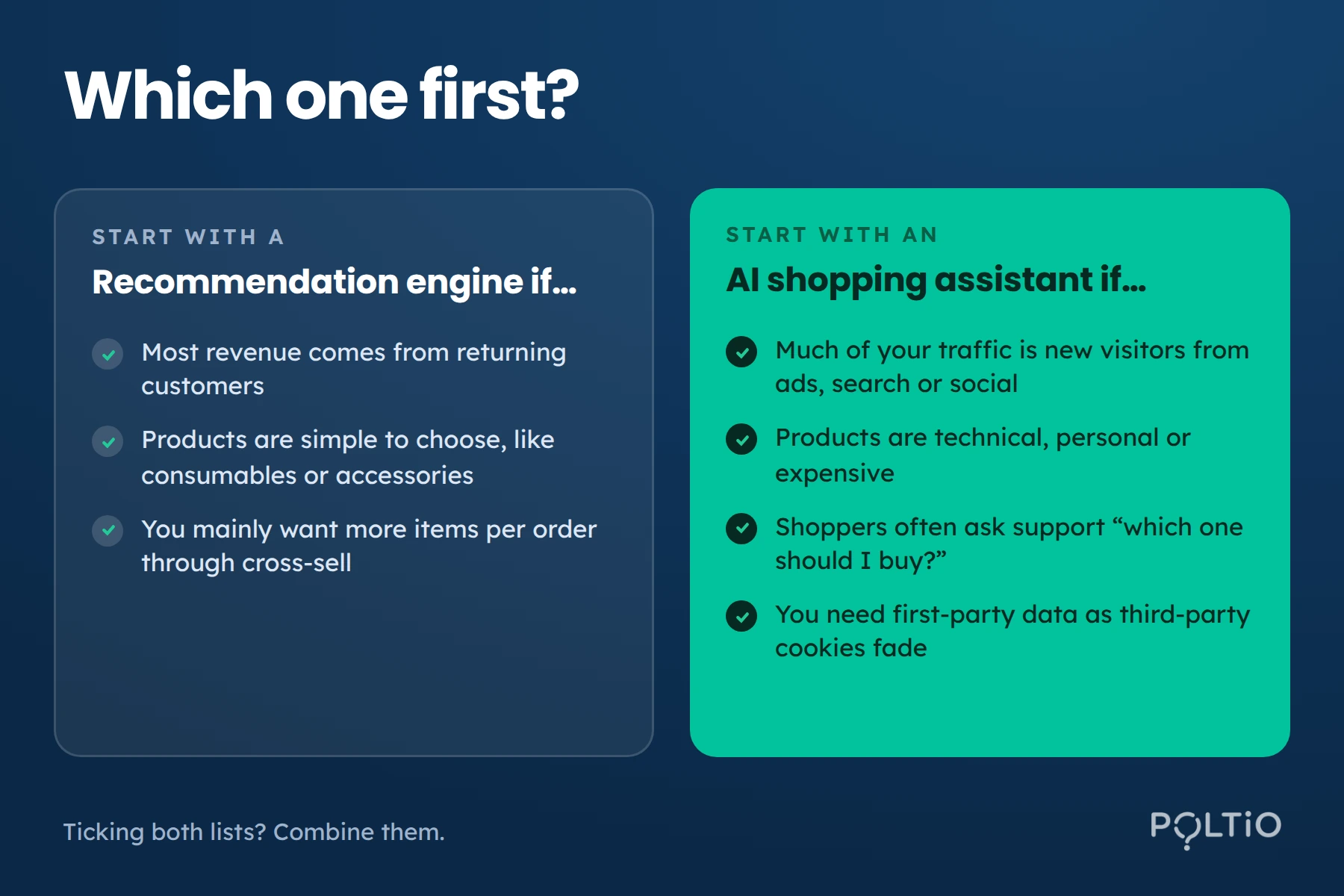
Choose a recommendation engine first if:
- Most of your revenue comes from returning customers.
- Your products are simple to choose (consumables, low-price accessories).
- You mainly want to increase items per order through cross-sell.
Choose an AI shopping assistant first if:
- A large share of your traffic is new visitors from ads, search or social.
- Your products are technical, personal or expensive (appliances, skincare, mattresses, electronics).
- Shoppers often contact customer service asking “which one should I buy?”
- You need first-party customer data as third-party cookies fade.
Most mid-size and enterprise stores tick boxes on both lists, which is why the real question is usually not which one, but how to combine them.
How do AI shopping assistants and recommendation engines work together?
They work best as a relay. The assistant captures stated intent at the start of the journey; the recommendation engine uses that intent for every recommendation after it.

- A new visitor lands on a category page from an ad. The engine knows nothing about them.
- The AI shopping assistant asks three questions and recommends a product that fits.
- The answers are stored as zero-party data: “runs 3x a week, road running, wide feet, budget under €150.”
- The recommendation engine uses them. Instead of bestsellers, the next carousel shows road shoes in wide fits within budget.
- Email and ads follow suit. Your CRM sends running content and relevant launches, not generic promotions.
The result: the assistant fixes the engine’s cold-start problem, and the engine extends the assistant’s personalization across the rest of the site and every later visit.
Where Poltio fits
Poltio is an AI-led guided commerce platform. It adds the “ask” layer that behavioral tools lack: AI shopping assistants and product recommendation quizzes that run on Shopify, custom CMSs or via Google Tag Manager, and pass every answer to your CRM and marketing stack.
Across customers, Poltio reports a 66% average conversion lift for shoppers in guided funnels compared with the site average, and about 20% higher basket value (usepoltio.com).
Frequently asked questions
Is an AI shopping assistant the same as a chatbot?
Not quite. A general chatbot answers questions, often about orders or returns. An AI shopping assistant is built specifically to help shoppers choose products, using your catalog and a structured flow of questions.
Do I need a recommendation engine if I have an AI shopping assistant?
If you have many returning customers or a large cross-sell opportunity, yes. The assistant is strongest at the first purchase decision; the engine is strongest at the next ones.
What is the cold-start problem?
The cold-start problem is when a recommendation system has too little data about a new user or product to make relevant suggestions. Asking shoppers directly, through an AI shopping assistant, is one of the most effective fixes.
Are AI product recommendations accurate for new visitors?
Behavior-based recommendations are usually weak for new visitors. Recommendations based on the visitor’s own answers can be accurate from the first session.
Give your first-time visitors a reason to stay. Book a Poltio demo or try the demo store.
Related reading: What Is a Guided Selling Platform? · Personalized Product Recommendations: How AI Improves Conversion · Ecommerce Recommendation Engine Buyer’s Guide