
Best Guided Selling Softwares for E-Commerce (2027): 7 Platforms Compared
Online shopping has a decision problem, not a discovery problem. Shoppers can find hundreds of products in seconds. Knowing which one is right for them is a different story. More options, more filters, and more product specs don’t necessarily make that decision easier.
Guided selling software bridges the gap between product discovery and purchase decisions. But as the category evolves, the real differentiators go beyond quizzes and product recommendations.
Where does guidance happen? How are recommendations made? And how is shopper intent data put to work?
These are the questions that define the next generation of guided selling. This comparison looks at seven platforms through that lens
Quick answer: For brands that want guided selling across the full journey (on-site, in campaigns and off-site) plus zero-party data that flows into their CRM, Poltio is the most complete option. Zoovu suits large manufacturers with complex, configurable catalogs. Octane AI and RevenueHunt are practical self-serve quiz apps, mainly for Shopify. Outgrow fits marketing teams that need many interactive formats. Neocom and Aiden are worth evaluating for AI-led and scripted product advice.
Why guided selling software matters now
Guided selling software helps online shoppers choose by asking about their needs and recommending the products that fit, with a reason for each pick. It shows up as AI shopping assistants, product finders, recommendation quizzes and conversational flows.
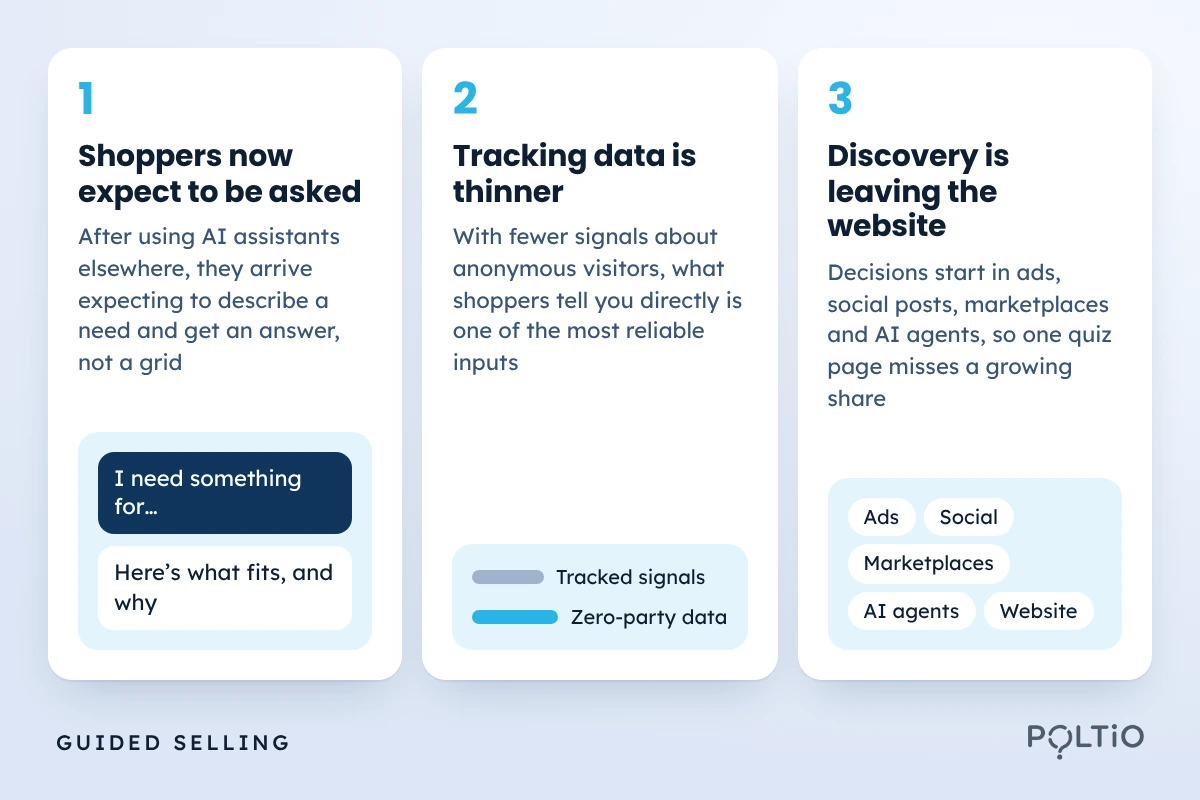
Three shifts have pushed it from a nice-to-have to a core part of the ecommerce stack:
- Shoppers now expect to be asked. People who use AI assistants elsewhere arrive on a store expecting to describe a need and get an answer, not a grid.
- Tracking data is thinner. With fewer signals about anonymous visitors, what shoppers tell you directly (zero-party data) has become one of the most reliable inputs for personalization.
- Discovery is leaving the website. Ads, social posts, marketplaces and AI agents are all places where a shopper can start a decision, so guidance that only lives on one quiz page misses a growing share of journeys.
How we evaluated the platforms
We build guided selling for brands such as Bugaboo, Arçelik and Teknosa, so we know where these projects succeed and where they stall. For this comparison we reviewed each vendor’s own website and documentation as of November 2026 and scored them on six questions:
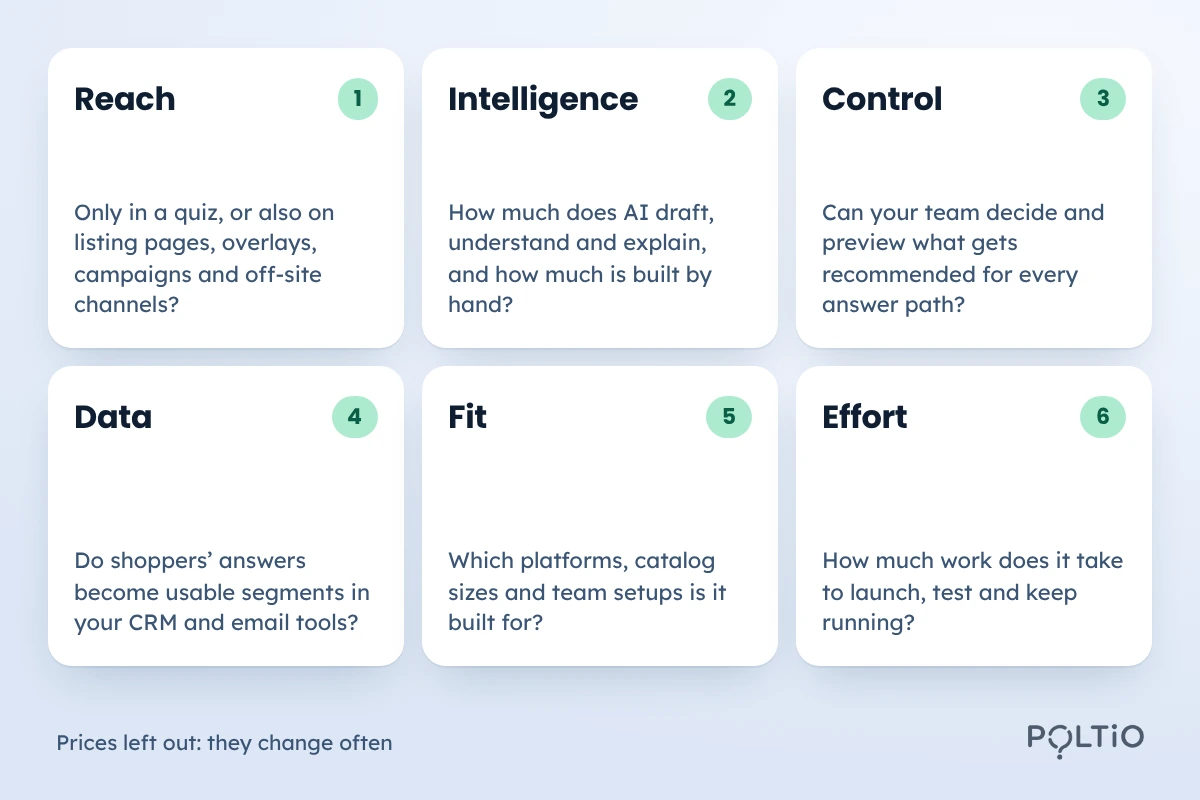
- Reach: Does guidance live only in a quiz, or also on listing pages, overlays, campaigns and off-site channels?
- Intelligence: How much does AI do (drafting flows, understanding answers, explaining recommendations) and how much do you build by hand?
- Control: Can your team decide and preview what gets recommended for every answer path?
- Data: Do shoppers’ answers become usable segments in your CRM and email tools?
- Fit: Which platforms, catalog sizes and team setups is it built for?
- Effort: How much work does it take to launch, test and keep running?
We’ve left prices out because they change often; check each vendor for current plans.
The 7 platforms at a glance

1. Poltio
Built for: retailers and brands that want to own the decision moment everywhere shoppers make one, and turn every answer into data they can use.
Most guided selling projects start with one quiz on one page. The trouble is that shoppers don’t decide in one place. They decide on a listing page, in a campaign, after a social ad or on a marketplace. Poltio is built as one AI-led platform with two suites, so the same intelligence follows the shopper across all of them.
Guided Selling Suite. AI shopping assistants tailored to your catalog, in the format each moment needs:
- A Guided Shopping Chatbot that explains why each product fits (Reasoned Suggestions), compares options side by side (Smart Compare) and suggests what goes with it (Pairs Perfectly With). Teknosa runs it on its earbuds listing page with smart product cards.
- A Full Page AI Shopping Assistant for deep product finders, like Bugaboo’s “find my pushchair” experience.
- Campaign, Seasonal and Gift Assistants for promotions, peak seasons and occasion-led shopping. Arçelik uses the Campaign Assistant on its campaigns page; Monster Notebook runs a Seasonal Shopping Assistant on its laptop listings.
- A Layover Shopping Assistant that opens over any page, as on Arçelik’s homepage.
Engagement Suite. This or That, trivia, quizzes and Gamification Studio formats that shoppers actually enjoy, each one capturing zero-party data. Data Lab then turns those answers into Smart Segments and SKU-level insight, and sends them to your CRM.

Beyond your website. Poltio experiences run in social posts, ads and influencer campaigns, and recommendations can lead to your site or a marketplace. Defy, for example, runs guided selling on Instagram and TikTok with its Takealot catalog.

Built for testing. One Poltio Tag manages placements, Smart Triggers, product-card entry points and A/B tests, so new ideas don’t wait for a development sprint. Poltio MCP opens the same guided selling and catalog intelligence to AI assistants.
Reported results: a +66% conversion lift within the flow and +20% average order value uplift across Poltio deployments.
Consider another option if: you only need a single, simple quiz on a small Shopify store this week.
2. Zoovu
Built for: global manufacturers and enterprise retailers with large, technical or configurable catalogs, in B2C and B2B.
Zoovu positions itself as a product discovery platform, combining product finders, site search, configurators and an AI shopping assistant under one vendor.
Where it shines: handling compatibility rules and complex product logic, and covering several discovery tools in one contract.
Trade-offs: it is built around enterprise teams, budgets and implementation timelines, so it can be more than mid-market brands need.
3. Octane AI
Built for: Shopify brands, often in beauty and wellness, that want a quiz mainly to grow email and SMS lists.
Octane AI is a Shopify quiz app with an AI builder and close ties to Shopify email and SMS tools, so quiz answers can drive follow-up flows.
Where it shines: quick setup inside the Shopify ecosystem and reporting on how quiz answers relate to revenue.
Trade-offs: it runs on Shopify only, and the guidance lives mainly in the quiz itself rather than across listing pages, campaigns or other channels.
4. Outgrow
Built for: marketing teams that need many kinds of interactive content, not only product recommendations.
Outgrow is an interactive content builder covering quizzes, calculators, assessments, polls and similar formats, with a broad set of marketing integrations.
Where it shines: variety of formats and templates for lead generation across industries.
Trade-offs: it isn’t built specifically for ecommerce catalogs, so product matching and recommendation logic take more manual work than in a dedicated guided selling platform.
5. RevenueHunt
Built for: small and mid-size stores that want a capable recommendation quiz and are happy to build it themselves.
RevenueHunt offers no-code product recommendation quizzes with branching logic and results pages, available on several ecommerce platforms.
Where it shines: an accessible starting point with self-serve setup and modest budgets.
Trade-offs: each quiz carries its own logic, which can become hard to manage with large catalogs, and advanced design customization may need code.
6. Neocom
Built for: retailers exploring AI-powered product advice on their site.
Neocom offers an AI sales assistant that guides shoppers through product choices on the retailer’s website.
Where it shines: an AI-first approach to on-site advice. [verify]
Trade-offs: check how much control your team has over recommendations, how answers reach your CRM, and which channels beyond the website are supported. [verify]
7. Aiden
Built for: European retailers that want to define product advice themselves, with AI as an option.
Aiden lets merchants build an advice model from their own product knowledge and run it as product finders on category pages and checks on product pages.
Where it shines: strong merchant control over what is recommended, and advice placed directly in the browsing flow.
Trade-offs: the advice model has to be built and maintained by your team, and its focus is mainly on the European market.
Which platform fits your situation?
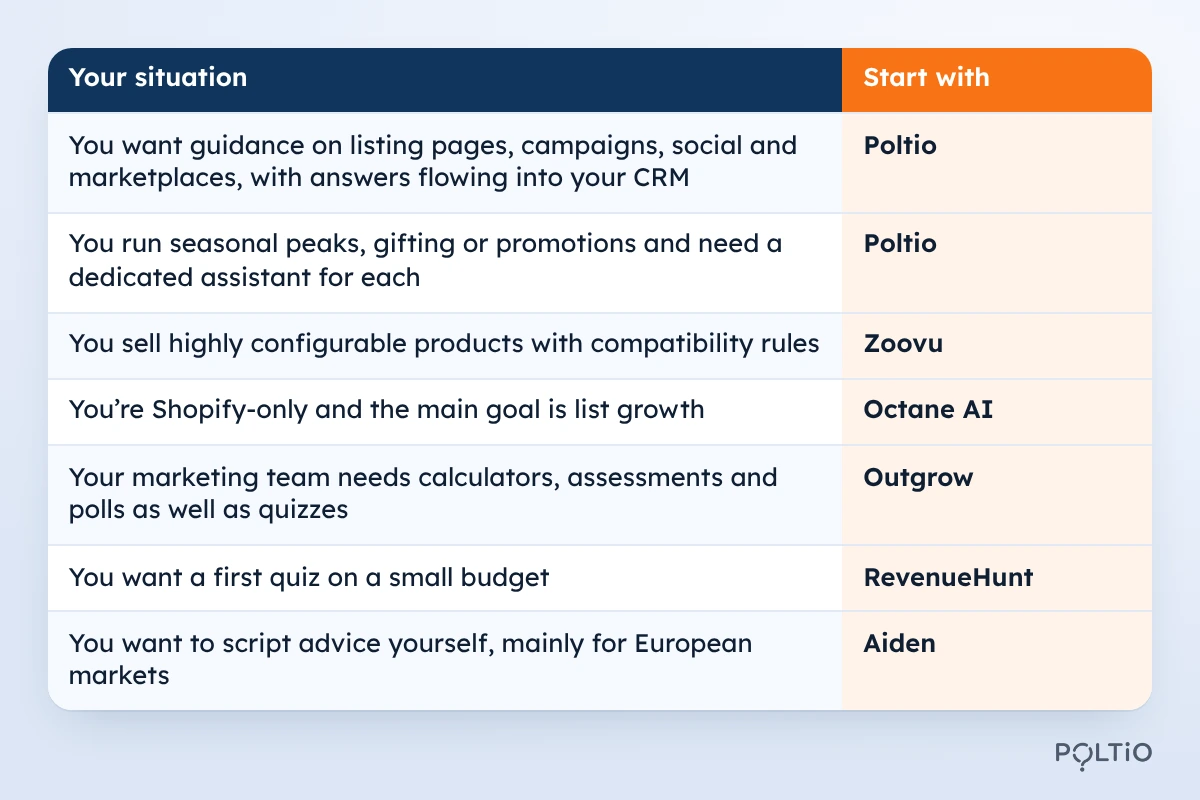
Before any demo, answer two questions as a team. First: where do our shoppers actually get stuck? If it’s in more than one place, a single quiz page won’t be enough. Second: what will we do with the answers? If the data never reaches your CRM, half the value of guided selling stays on the table.
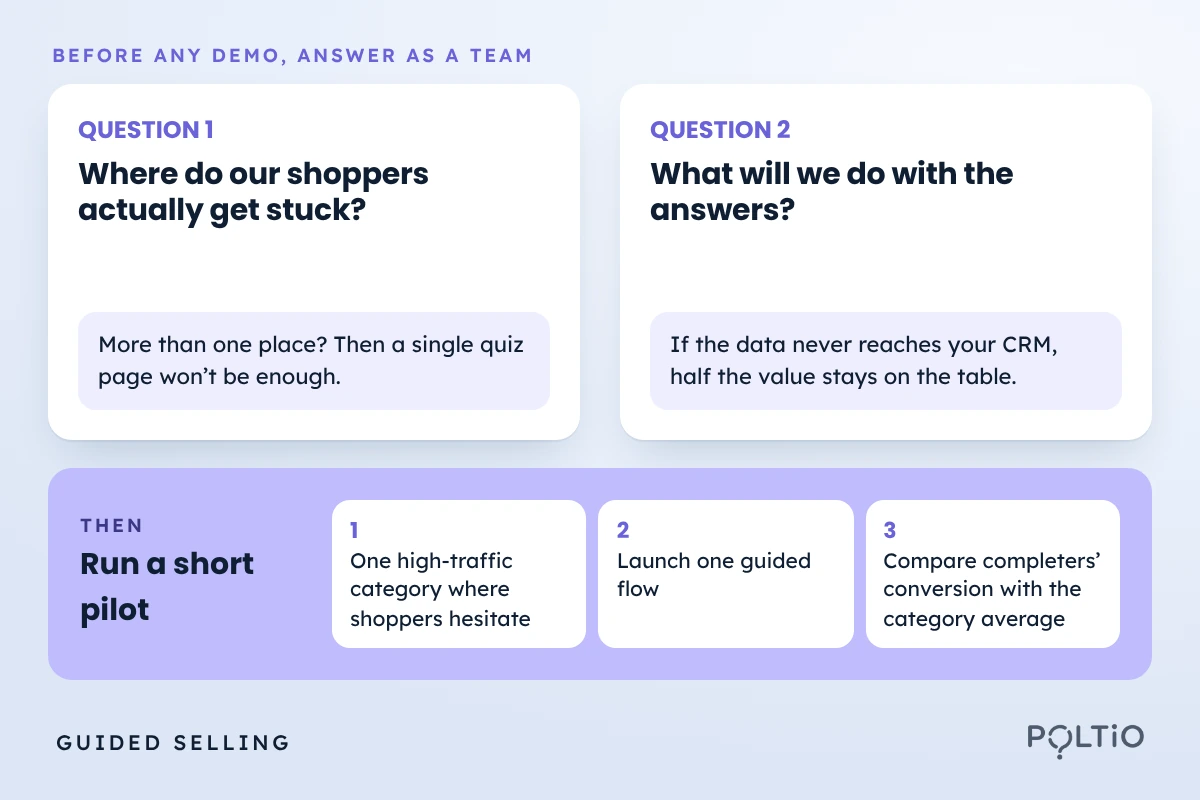
Then run a short pilot. Pick one high-traffic category where shoppers hesitate, launch one guided flow and compare the conversion of shoppers who complete it with the category average.
Frequently asked questions
What is guided selling software?
Guided selling software helps online shoppers choose by asking about their needs and recommending matching products with a reason for each, through AI shopping assistants, product finders or recommendation quizzes.
What is the best guided selling software for ecommerce?
It depends on scope. For guided selling across on-site, campaign and off-site journeys, combined with zero-party data and CRM integration, Poltio is a strong fit. For complex configurable catalogs, Zoovu; for a simple Shopify quiz, Octane AI or RevenueHunt.
How is guided selling different from a product quiz?
A product quiz is one format of guided selling. Guided selling also includes conversational assistants, full-page product finders, overlays on listing pages, gift and seasonal assistants, and experiences that run outside the website.
Does guided selling work outside the website?
It can. With Poltio, guided selling can run in social posts, ads and influencer campaigns, and recommendations can lead to your own site or to a marketplace.
How long does it take to launch guided selling?
It varies by platform and scope. Self-serve quiz apps can go live quickly; platforms with AI-drafted flows and a single tag for placements shorten the path for larger catalogs too.
Action List for Brands
- Identify your decision friction. Pinpoint high-traffic categories where shoppers struggle to choose, and prioritize the touchpoints where guidance can make the biggest impact.
- Launch, test and optimize. Start with one AI shopping assistant, test different placements and measure conversion uplift, AOV and engagement.
- Activate shopper intent data. Connect zero-party data to your CRM to power smarter segmentation, personalized campaigns and future shopping experiences.