
Ecommerce Recommendation Engine Buyer’s Guide: Features to Look For

Every vendor says “AI-powered”. Every demo looks impressive on a catalog the vendor chose. The real test is how the engine performs on your products, your traffic and your new visitors, and that’s what the questions in this guide are designed to reveal.
Quick answer: An ecommerce recommendation engine is software that suggests relevant products to each shopper using behavioral data, product attributes and, in some systems, the shopper’s own stated preferences. When choosing one, evaluate how it handles new visitors (the cold-start problem), whether it can use stated intent, how well it integrates with your platform and CRM, how much merchandising control you keep and whether you can measure incremental revenue.
What a recommendation engine does, and what it doesn’t
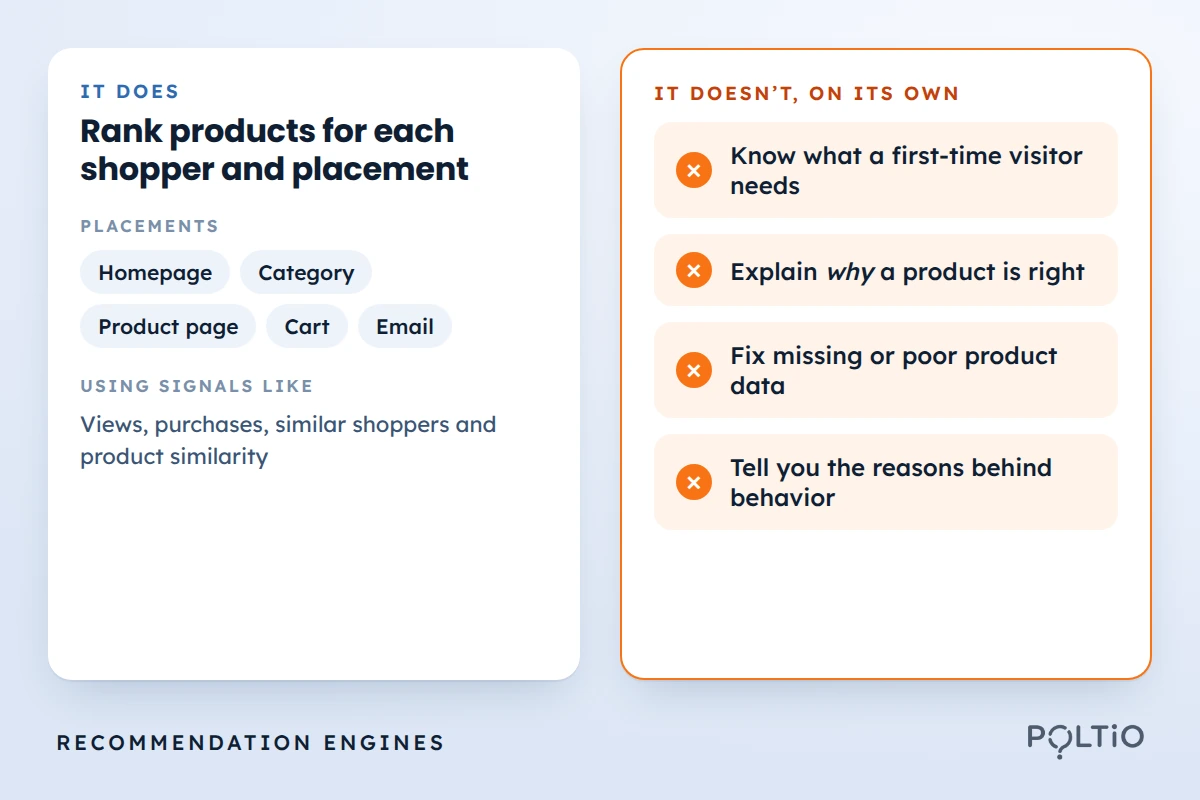
It does: rank products for each shopper and placement (homepage, category, product page, cart, email) using signals like views, purchases, similar shoppers and product similarity.
It doesn’t, on its own:
- Know what a first-time visitor needs
- Explain why a product is right
- Fix missing or poor product data
- Tell you the reasons behind shopper behavior
Those gaps are where most disappointment with recommendation engines comes from, and where the right questions during evaluation make the biggest difference.
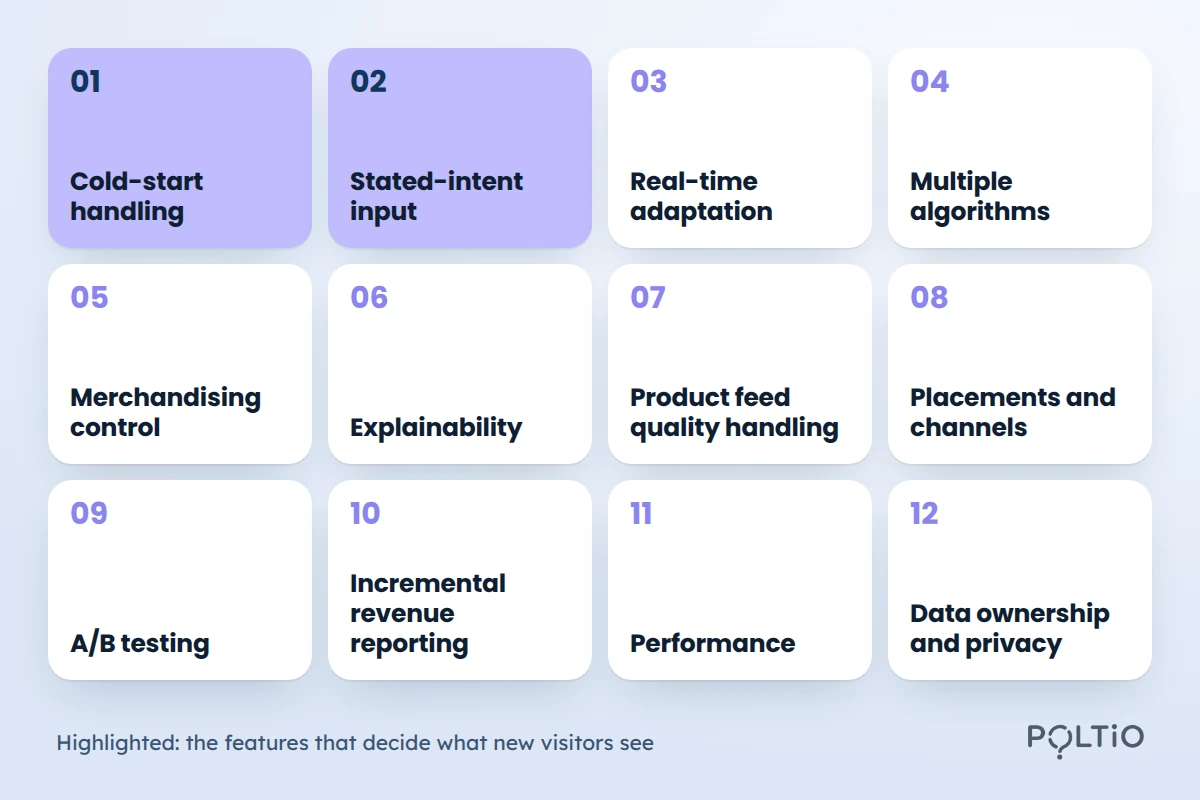
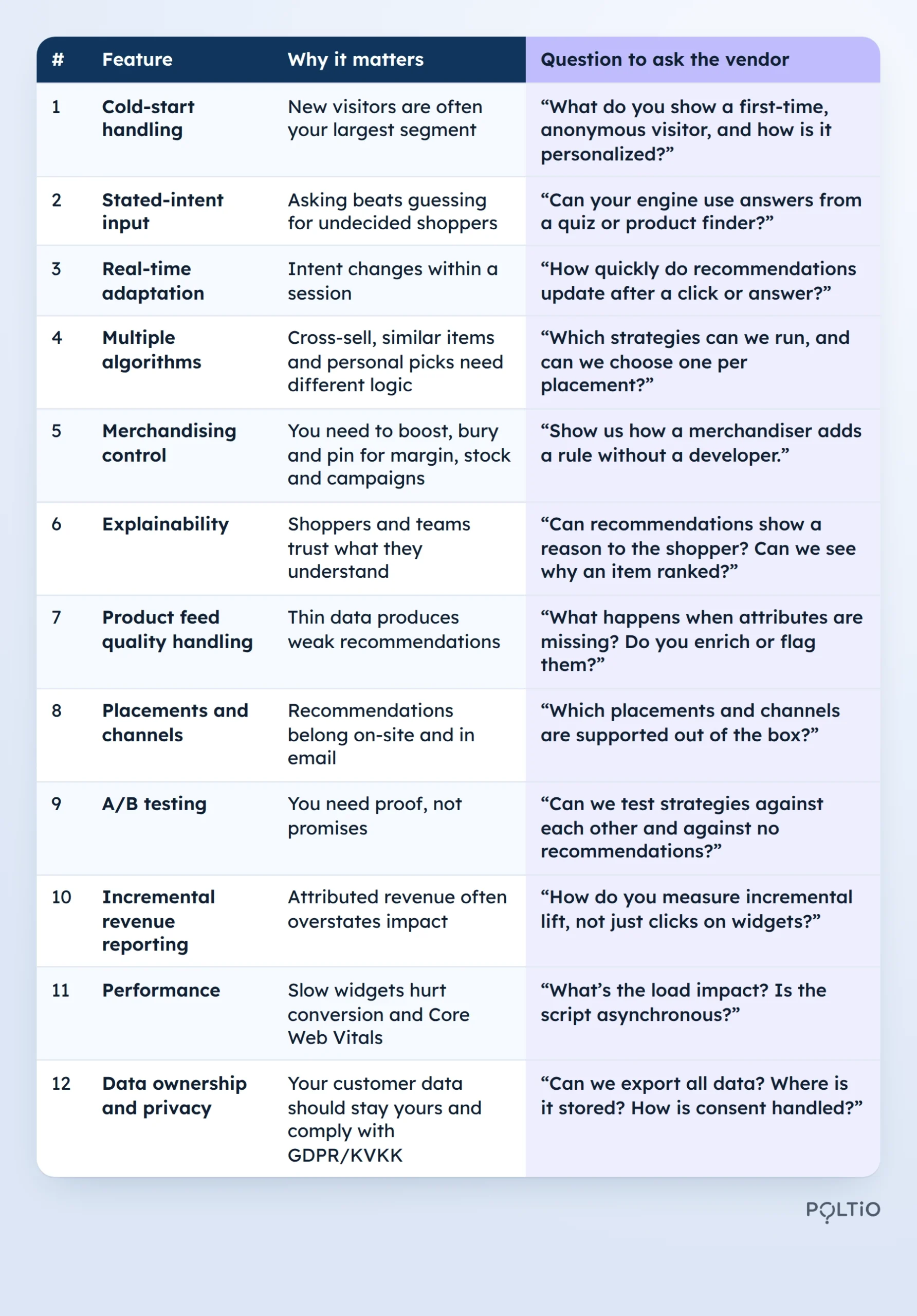
12 features to evaluate
Cold start: the problem most engines hide
The cold-start problem is when a recommendation engine has too little data about a new visitor, or a new product, to make relevant suggestions. Most engines fall back to bestsellers, which look fine in a demo and do little for a first-time visitor with a specific need.
Test it during evaluation:
- Open the vendor’s live demo or a customer site in a private browser window.
- Land on a category page as a new visitor.
- Note what’s recommended. Is it personal in any way, or just popular?
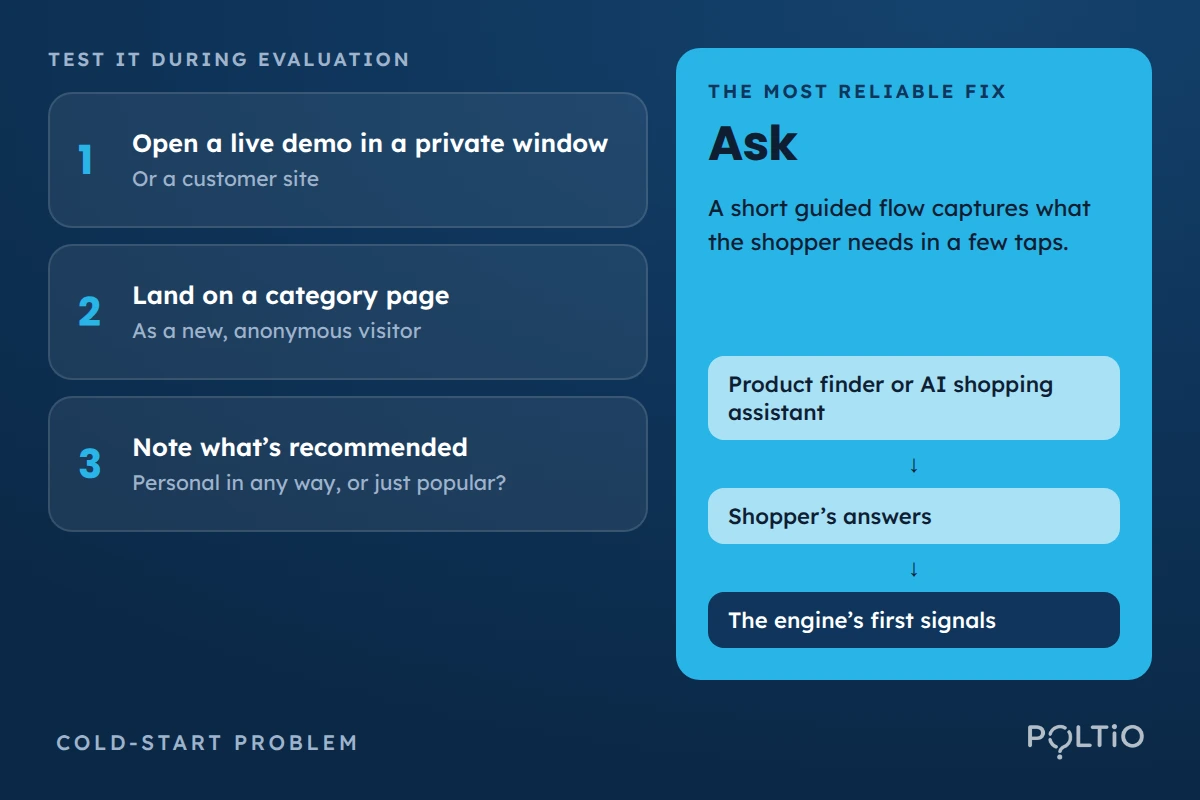
The most reliable fix is to ask. A short guided flow (a product finder or AI shopping assistant) captures what the shopper needs in a few taps, and those answers become the recommendation engine’s first signals. This is where platforms like Poltio complement a recommendation engine: across Poltio customers, shoppers in guided funnels convert 66% better than the site average (usepoltio.com).
Integration checklist
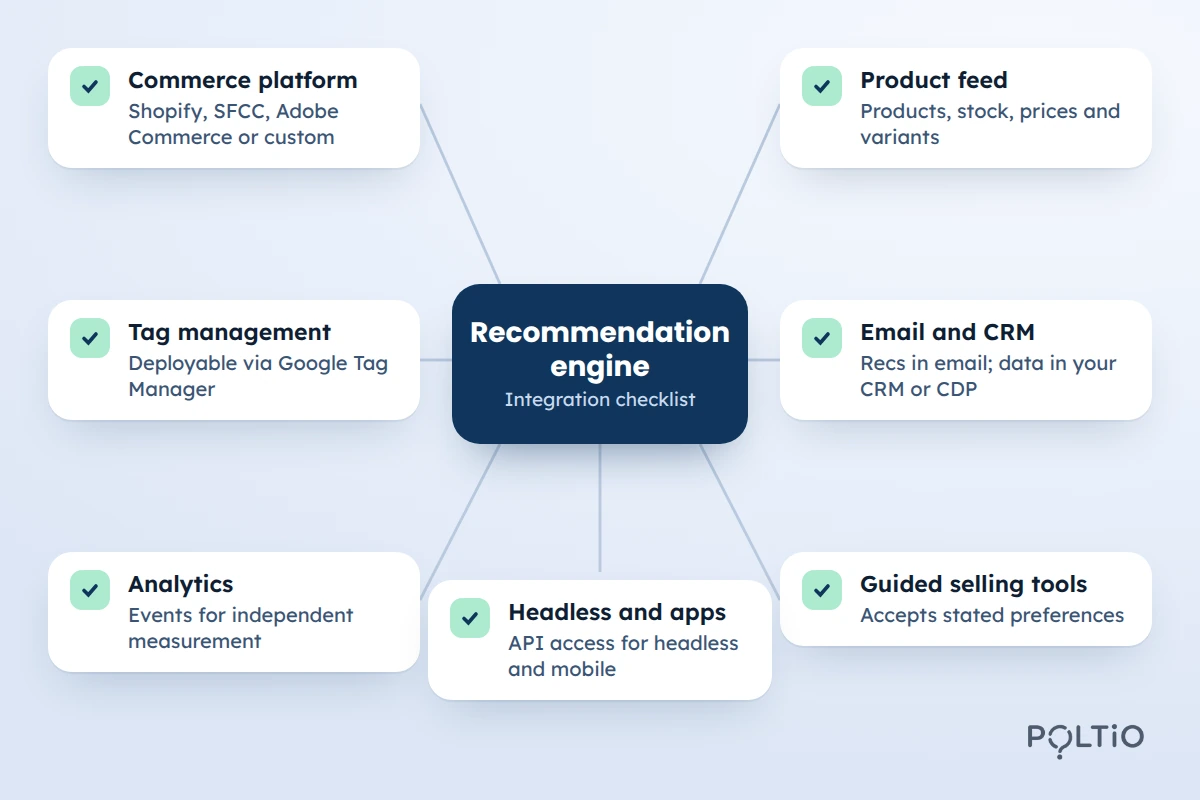
- Commerce platform: native support for your platform (Shopify, Salesforce Commerce Cloud, Adobe Commerce or a custom build)
- Product feed: automatic sync of products, stock, prices and variants
- Tag management: deployable via Google Tag Manager if needed
- Email and CRM: recommendations in email; shopper data in your CRM or CDP (e.g., Klaviyo, Braze, Insider, Salesforce, Segment)
- Analytics: events in your analytics tool for independent measurement
- Guided selling tools: can accept stated preferences from product finders and quizzes
- Headless and apps: API access if you run a headless front end or mobile app
Recommendation engine pricing models
| Model | How it works | Watch out for |
| Flat monthly subscription | Fixed fee by plan or traffic tier | Tier jumps as traffic grows |
| Usage-based | Priced per session, pageview or API call | Unpredictable costs at peak season |
| Revenue share | Percentage of attributed revenue | Attribution rules that overstate impact |
| Enterprise annual contract | Custom price with services | Implementation fees and minimum terms |
Whatever the model, compare the cost against incremental revenue measured in an A/B test, not against the vendor’s attributed revenue.
RFP template: questions to send vendors
Copy these into your RFP or vendor questionnaire.
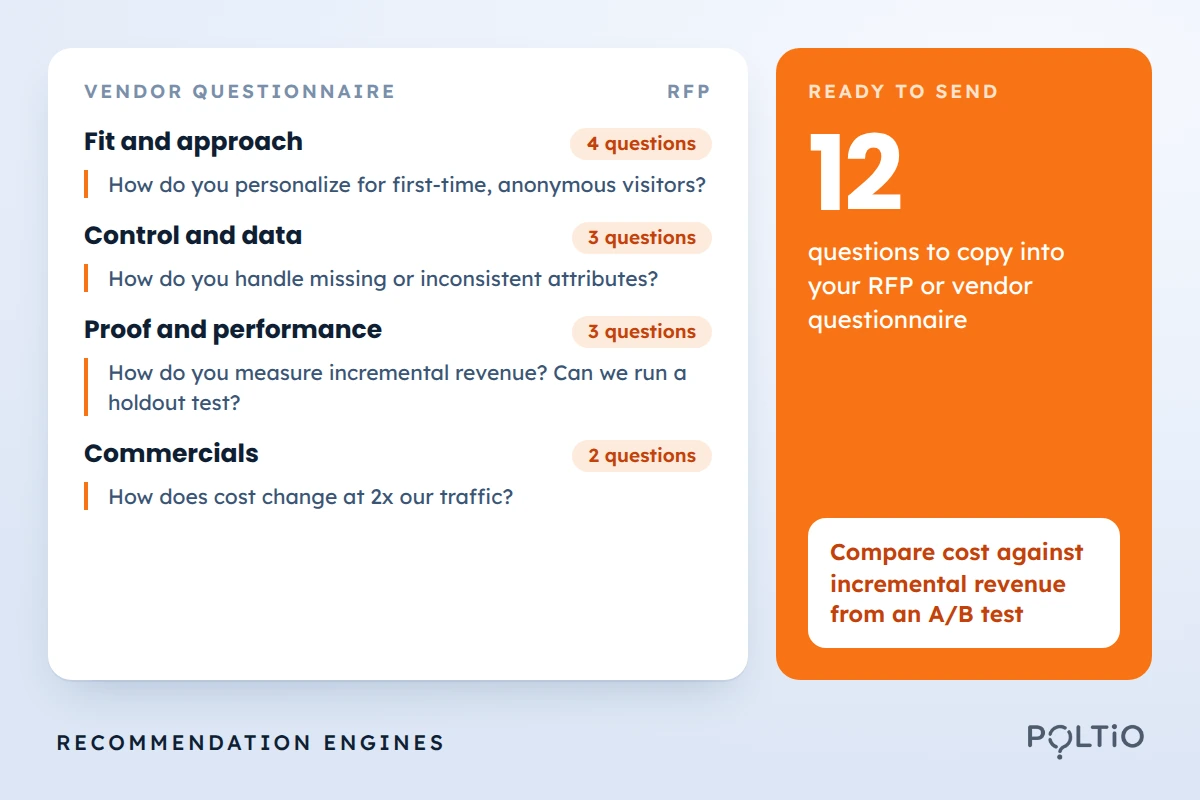
Fit and approach
- Which ecommerce platforms and front ends do you support natively?
- Which recommendation strategies do you offer, and which do you recommend for our category?
- How do you personalize for first-time, anonymous visitors?
- Can your engine use shoppers’ stated preferences from quizzes or product finders?
Control and data
- What merchandising rules can non-technical users set?
- How do you handle missing or inconsistent product attributes?
- Where is customer data stored, how is consent managed and can we export everything?
Proof and performance
- How do you measure incremental revenue? Can we run a holdout test?
- What is the page-load impact of your scripts?
- Share two case studies from our industry with baseline, lift and time period.
Commercials
- What is the pricing model, and how does cost change at 2x our traffic?
- What are implementation time, fees and minimum contract terms?
Frequently asked questions
What is an ecommerce recommendation engine?
An ecommerce recommendation engine is software that automatically suggests relevant products to online shoppers based on their behavior, product attributes and the behavior of similar shoppers.
What’s the difference between a recommendation engine and a recommendation system?
The terms are used interchangeably. “Recommendation system” is more common in technical and academic contexts; “recommendation engine” in commercial ones.
How do I measure the ROI of a recommendation engine?
Run an A/B test with a holdout group that sees no personalized recommendations, and compare revenue per visitor. Attributed revenue from widget clicks tends to overstate impact.
Do I need a recommendation engine and a guided selling tool?
Many stores benefit from both. Recommendation engines are strongest for returning shoppers and cross-sell; guided selling is strongest for new and undecided shoppers. Guided selling answers can also improve the engine’s recommendations.
Solve cold start before you buy another algorithm. Book a Poltio demo to see how guided flows feed stated intent into your recommendations, or try the demo store.
Related reading: AI Shopping Assistant vs. Product Recommendation Engine · Personalized Product Recommendations · Why Product Data Enrichment Matters