
Ecommerce Site Search vs. Intent-Driven Guided Commerce: Why Search Alone Isn’t Enough

Search works when shoppers know what to type. For everyone else, there’s a blinking cursor, and then a bounce.
Ecommerce teams invest heavily in site search, and for good reason: shoppers who search often show strong purchase intent. But a search bar can only answer the question it’s given. When a shopper doesn’t know the product name, the category or the right words, search has nothing to work with.
The short answer: Ecommerce site search helps shoppers find products they can already describe, by matching typed queries to the catalog. Intent-driven guided commerce helps shoppers who can’t describe what they need, by asking questions about their situation and recommending matching products. Search serves known intent; guided commerce uncovers it. The strongest stores use both.
What ecommerce site search does well
Ecommerce site search is the search bar and results system on an online store that matches shoppers’ typed queries to products. Modern site search engines handle typos, synonyms, autocomplete and merchandising rules, and increasingly use AI to understand natural language.
Search is at its best for known-item and known-category queries:
- “iPhone 16 case” → exact product type
- “Nike Pegasus 41” → exact product
- “black ankle boots size 39” → clear attributes

For these shoppers, a fast, accurate search engine is the shortest path to checkout. If your search struggles with them, fix that first.
Where site search breaks
Search assumes the shopper can translate a need into words that match your catalog. That breaks down in four situations:
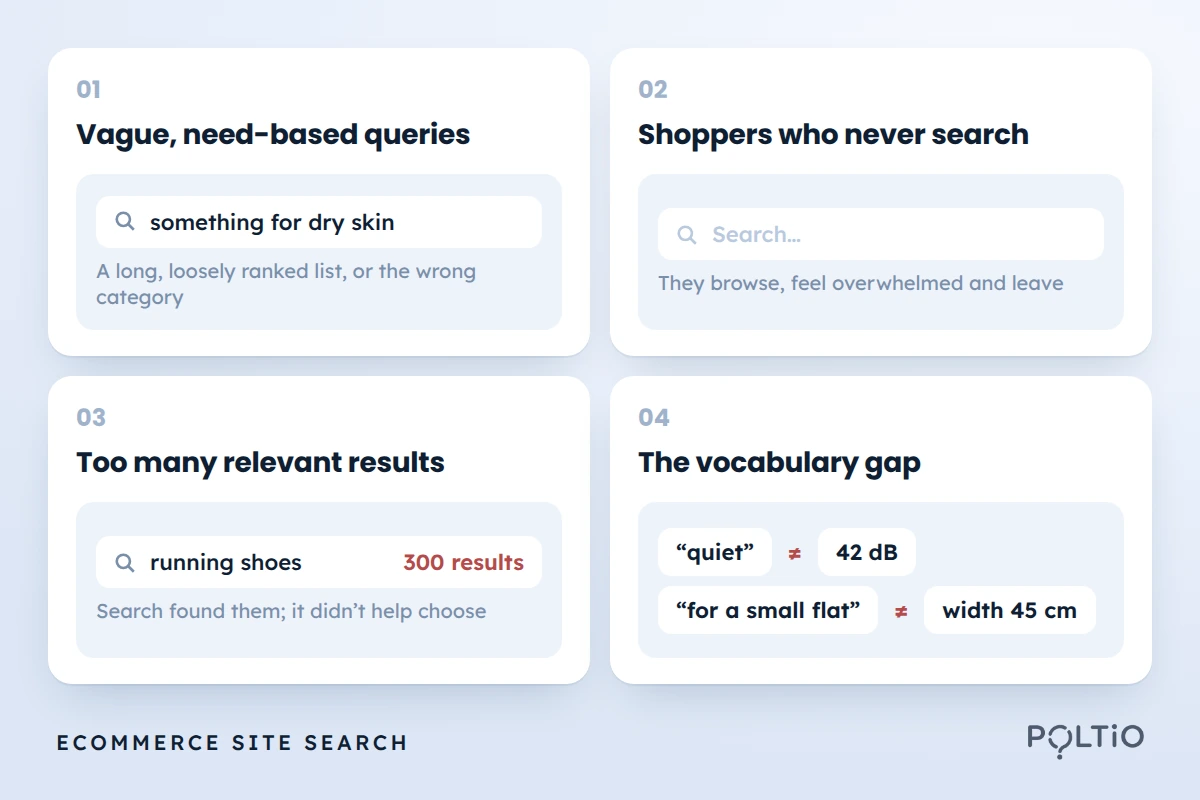
1. Vague or need-based queries
“Gift for my dad”, “something for dry skin”, “good laptop for university”. The query describes a situation, not a product. Search returns a long, loosely ranked list, or the wrong category entirely.
2. Shoppers who don’t search at all
Many visitors, especially first-timers on mobile, never touch the search bar. They browse, feel overwhelmed and leave. Search can’t help someone who doesn’t use it.
3. Too many relevant results
“Running shoes” is a clear query that returns 300 products. Search found them; it didn’t help choose between them.
4. The vocabulary gap
Shoppers say “quiet”; your catalog says “42 dB”. Shoppers say “for a small flat”; your catalog says “width 45 cm”. Even AI search can only bridge this gap if the product data holds the right attributes. In each case, the shopper has intent, but not the words, knowledge or patience to express it as a query.
What intent-driven guided commerce adds
Intent-driven guided commerce is an approach to product discovery that starts with the shopper’s needs rather than their search query. It uses guided selling flows, such as product finders, quizzes and AI shopping assistants, to ask a few questions, understand the shopper’s situation and recommend matching products with a clear reason for each.
It adds three things search can’t:
- It starts the conversation. Instead of waiting for a query, it invites the shopper in: “Looking for a laptop? Tell us how you’ll use it.”
- It translates needs into specs. “I edit videos for YouTube” becomes a dedicated GPU, 32 GB RAM and a colour-accurate screen.
- It narrows to a decision. Not 300 results, but two or three, with the trade-offs explained.
And because shoppers state their needs directly, every session creates zero-party data you can reuse in email, ads and personalization.
Site search vs. AI search vs. guided commerce
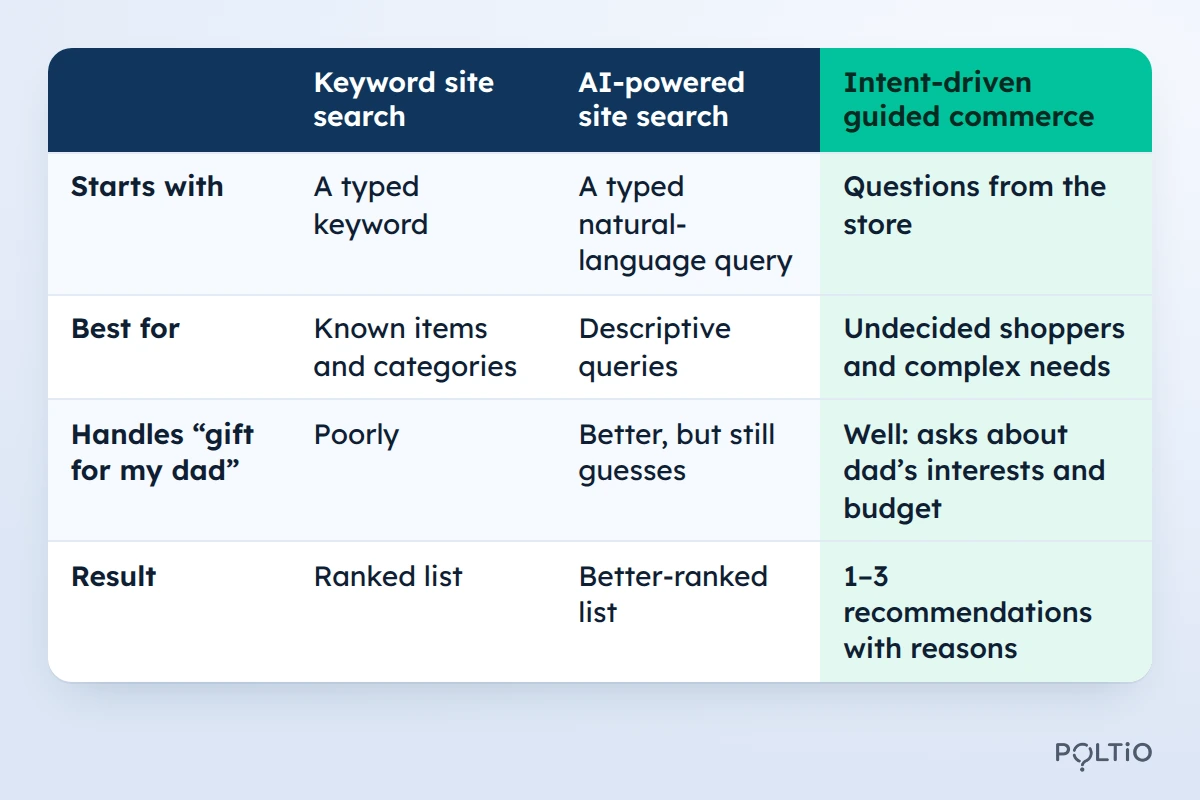

AI search is a real improvement, and worth investing in. But it’s still reactive: it needs the shopper to start typing and to describe the need well. Guided commerce is proactive, which is why the two complement each other rather than compete.
How to combine site search and guided commerce
The goal is to route each shopper to the tool that fits their intent. Five practical ways to connect them:

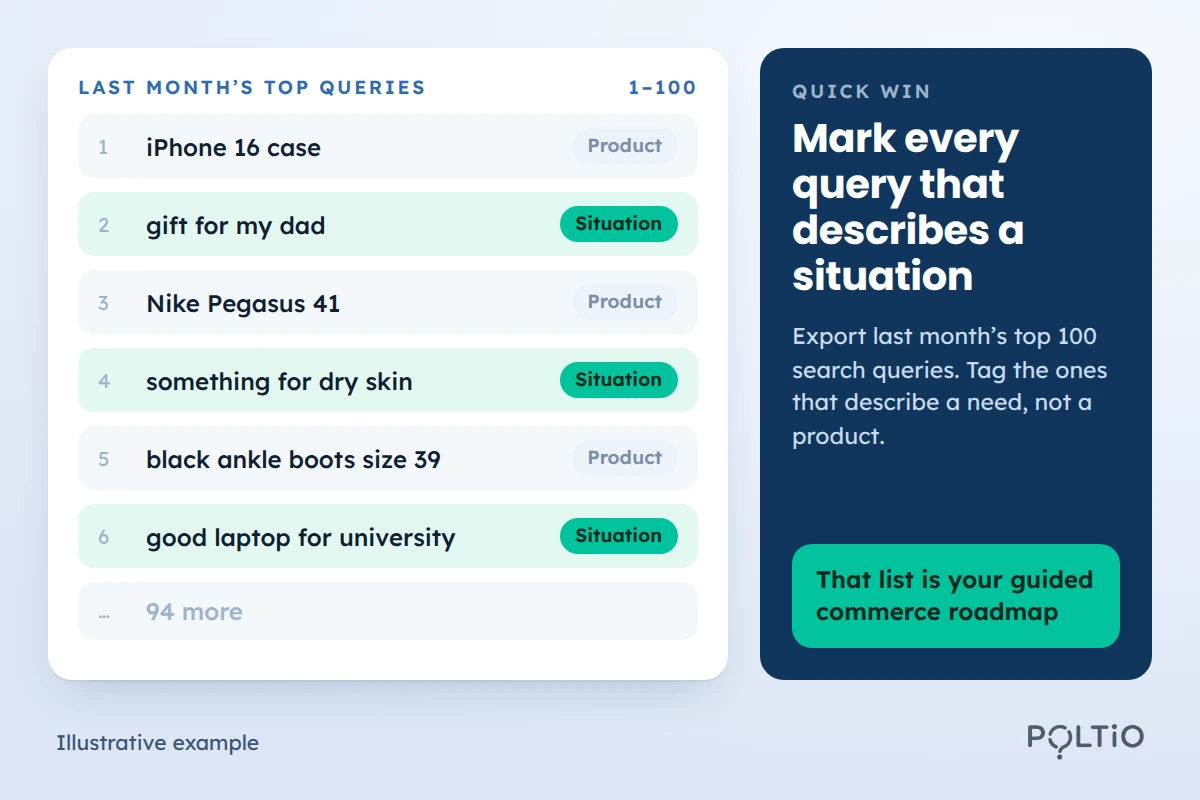
Quick win: Export last month’s top 100 search queries. Mark every query that describes a situation rather than a product. That list is your guided commerce roadmap.
When shoppers do take the guided path, results follow: across Poltio customers, shoppers in guided funnels convert 66% better than the site average (usepoltio.com).
Frequently asked questions
What is ecommerce site search?
Ecommerce site search is the search function on an online store that matches shoppers’ queries to products, often with features like autocomplete, typo tolerance, synonyms and merchandising rules.
Is AI search enough for product discovery?
AI search understands natural-language queries better than keyword search, but it still depends on shoppers starting a search and describing their need well. Guided commerce reaches undecided shoppers who don’t.
What is guided commerce?
Guided commerce is an ecommerce approach that helps shoppers choose by asking about their needs and recommending matching products through product finders, quizzes or AI shopping assistants.
Should I invest in site search or guided selling first?
If shoppers with clear queries can’t find products, fix search first. If most visitors browse without searching, bounce from category pages or ask customer service “which one should I buy?”, start with guided selling.
Help the shoppers your search bar can’t. Book a Poltio demo or try the demo store.
Related reading: Guided Selling vs. Traditional Product Filters · What Is a Guided Selling Platform? · Ecommerce Recommendation Engine Buyer’s Guide