
What Is a Product Recommendation Quiz? Examples & Best Practices

The best product quizzes feel like talking to your favorite shop assistant. The worst feel like filling in a tax form. Both ask questions. Both end with a product. The difference is in the details: how many questions, how they’re worded, what the results page says and what happens to the answers afterwards. This guide covers all of it, with examples you can borrow.
Quick answer: A product recommendation quiz is an interactive set of questions on an ecommerce site that asks shoppers about their needs, preferences or situation and then recommends the products that match their answers. It helps undecided shoppers choose faster, increases conversion and collects zero-party data brands can use for personalization.
Key takeaways
- Great quizzes ask 3–6 questions about the shopper, not about product specs.
- The results page matters as much as the questions: explain why each product fits.
- Every answer is zero-party data; plan how you’ll use it before you launch.
How does a product recommendation quiz work?
A product recommendation quiz works in three steps. It asks the shopper a few questions, maps each answer to product attributes in your catalog, and shows the best-matching products with a short explanation. A question like “How would you describe your skin by midday?” with the answer “Shiny on my forehead and nose” maps to combination skin, which filters the catalog to products tagged for that skin type. Three or four such questions narrow hundreds of products to a confident shortlist.

Product recommendation quiz examples
Editor’s note: add a screenshot of each quiz. Confirm Poltio customer examples and permissions with the account team before publishing.
1. Arçelik: appliance finder
Industry: Home appliances · Format: Product finder
Appliances are the classic case for a quiz: shoppers don’t know what capacity, energy class or program set they need. Arçelik’s guided flow asks about household and usage instead. Result: a 620% conversion uplift and 21% higher average order value with Poltio (usepoltio.com).
What to copy: Questions about life, not specs.
2. MediaMarkt: mobile-first electronics finder
Industry: Consumer electronics · Format: Product finder
Electronics shoppers on mobile face long spec lists on small screens. A tap-through finder replaces filter scrolling. Result: a 309% mobile conversion uplift with Poltio (usepoltio.com).
What to copy: Design for thumbs first: big answer buttons, one question per screen.
3. Warby Parker: frame finder quiz
Industry: Eyewear · Format: Style quiz
The quiz asks about face shape, preferred fit and style, then recommends frames to try. It turns an overwhelming catalog into a short, personal edit.
What to copy: Image-based answers for visual products.
4. Prose: custom hair care consultation
Industry: Beauty · Format: Consultation quiz
A longer quiz covering hair type, goals, lifestyle and even local climate. It works because the result is a personalized formula, so shoppers accept more questions.
What to copy: Question count can grow when the payoff clearly grows too.
5. Function of Beauty: hair goals quiz
Industry: Beauty · Format: Product quiz
Shoppers pick hair type and up to several goals, and the answers shape the product. The quiz is the product experience.
What to copy: Let shoppers pick multiple goals where real life isn’t either/or.
6. Sports retailer: activity-based gear finder
Industry: Sports and outdoor · Format: Product finder
A running shoe finder asks how often, where and how far you run, and whether you’ve had injuries. Terrain and frequency map to cushioning, grip and drop.
What to copy: Ask about the activity; the gear follows.
7. Baby brand: stroller advisor https://www.bugaboo.com/us-en/find-my-stroller-quiz/
Industry: Baby and family · Format: Product advisor
Questions about city vs. countryside, car size, public transport and a second child map to stroller weight, fold type and convertibility.
What to copy: Explain trade-offs in the results (“lighter, but smaller basket”).
8. Food and beverage brand: flavor finder
Industry: FMCG · Format: Personality-style quiz
A playful “which flavor are you?” quiz drives engagement in campaigns and collects taste preferences at scale.
What to copy: For low-price products, fun drives completion more than precision does.
What the best examples have in common
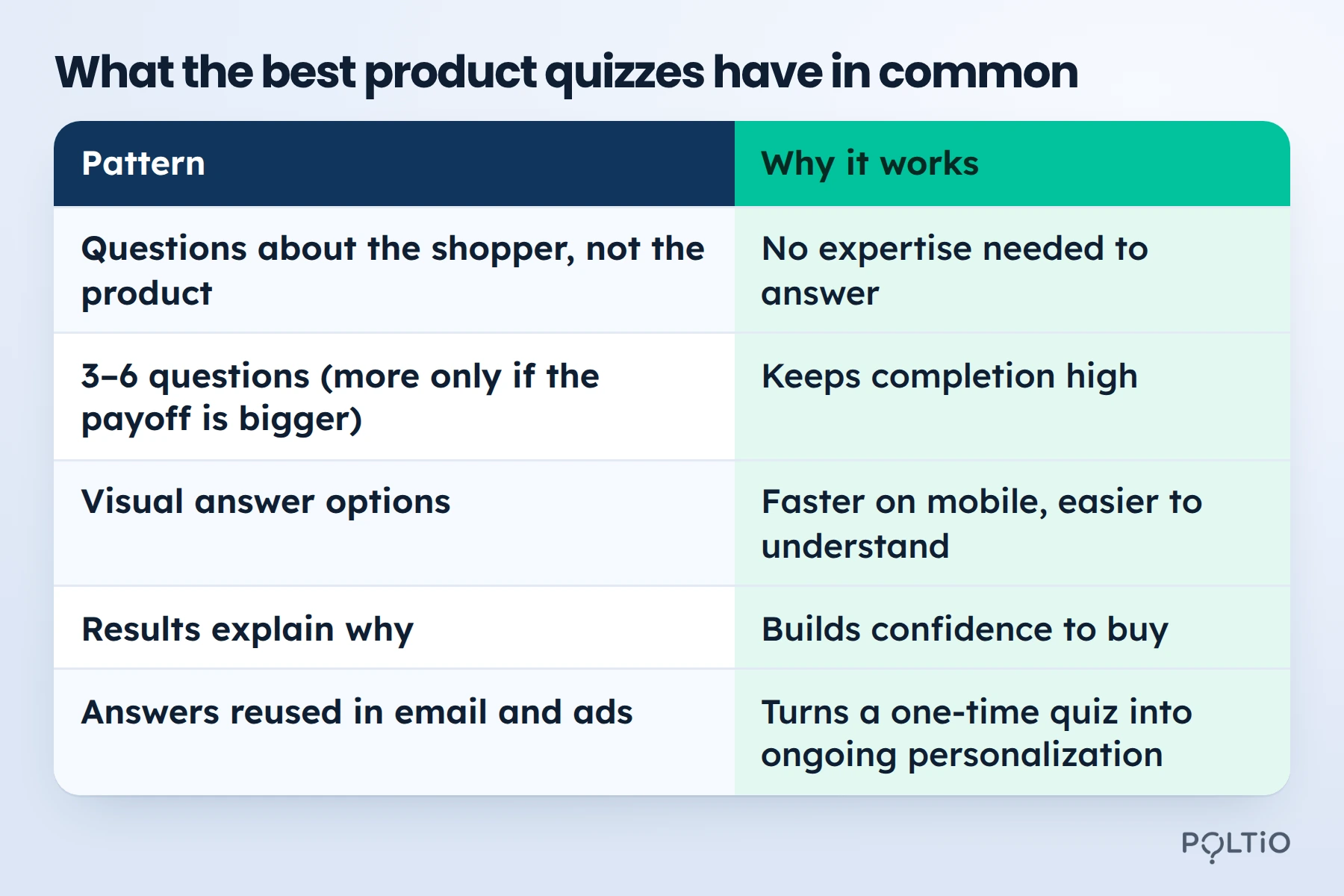
10 best practices for product recommendation quizzes

- Start with a clear promise. “Find your perfect running shoe in 30 seconds” beats “Take our quiz”. Say what they get and how long it takes.
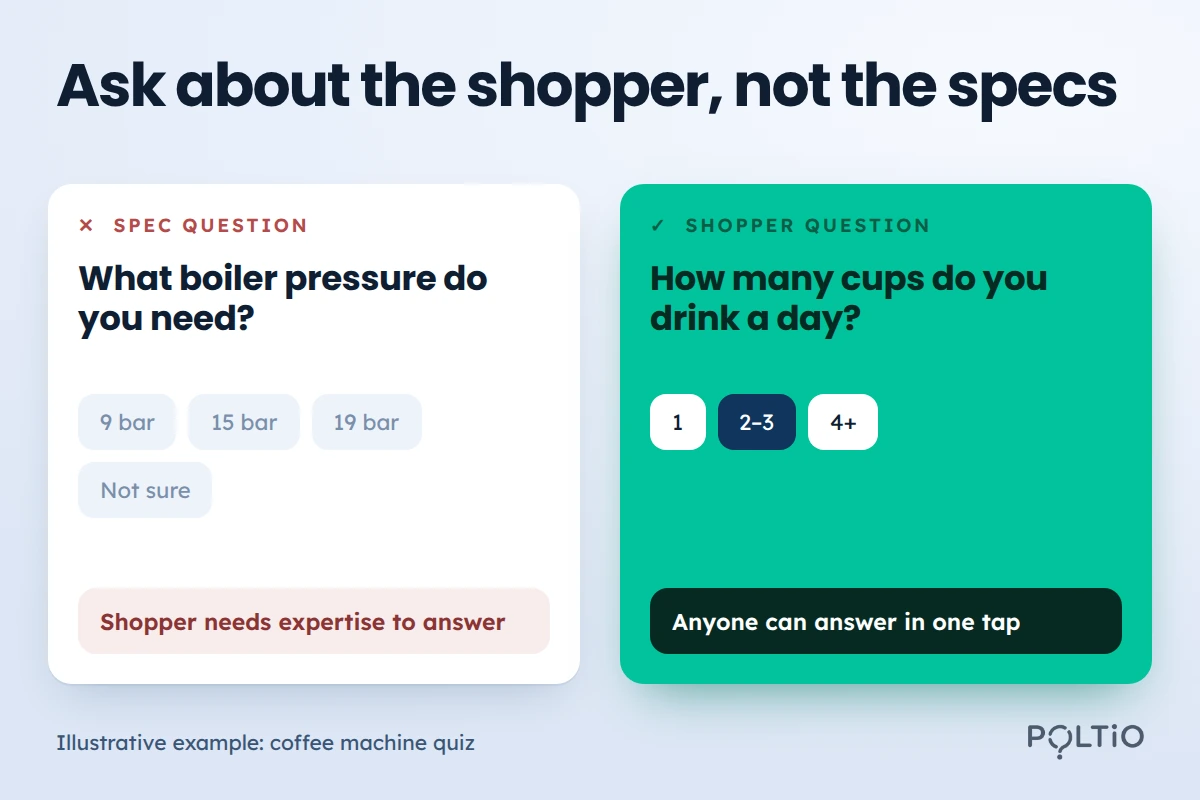
- Ask about the shopper, not the specs. “How many cups do you drink a day?” is easy. “What boiler pressure do you need?” isn’t.
- Keep it to 3–6 questions. Each question should remove a real share of the catalog. If an answer never changes the result, cut the question.
- Put the easiest question first. A one-tap opener builds momentum; save budget and personal questions for later.
- Use images for visual choices. Colors, styles, rooms and body types are faster to recognize than to read.
- Show progress. A progress bar or “Question 2 of 4” reduces drop-off.
- Ask for email at the right moment. Offer to send the results after the last question, not as a gate before it. Make it optional, or be clear about the value exchange.
- Explain every result. “Recommended because you run on trails 3x a week” builds trust. A bare product grid doesn’t.
- Never show an empty result. Design a fallback for every combination, like the closest match or a curated bestseller set.
- Close the loop with your data. Send answers to your CRM or email platform so the quiz keeps paying off after the session ends.
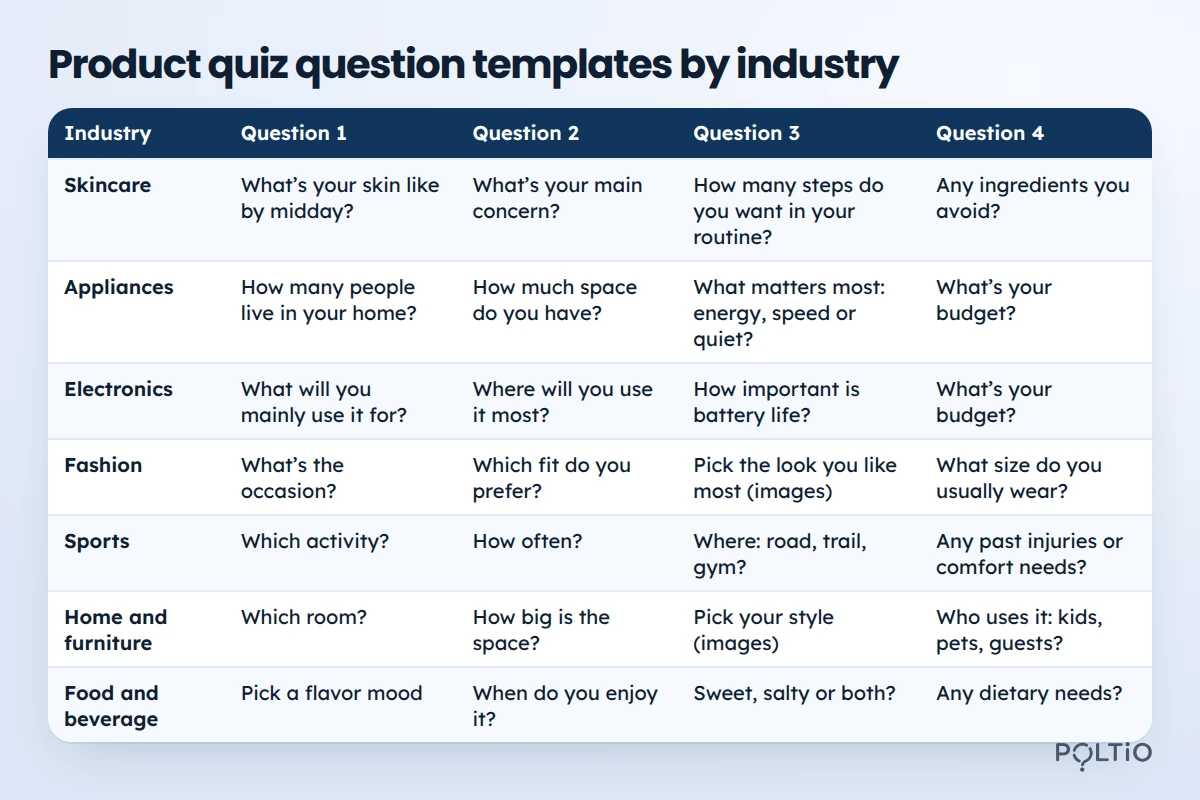
Critical question templates by industry
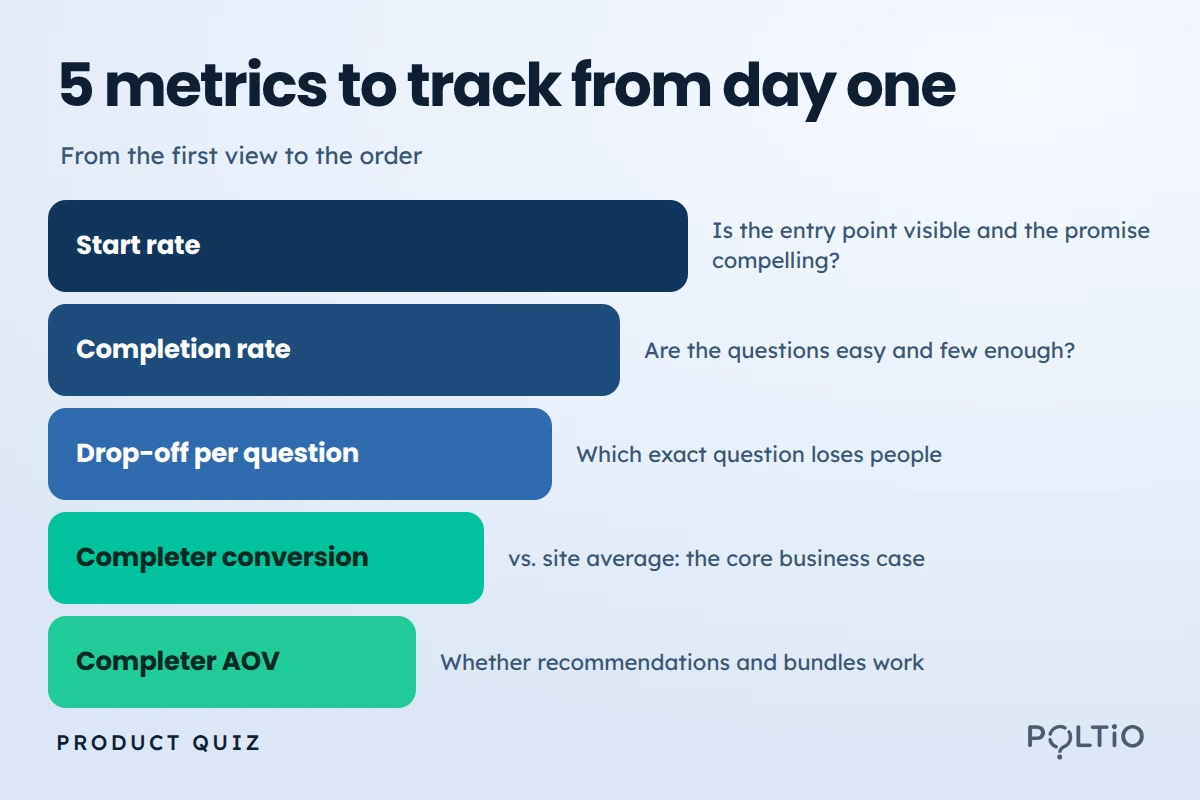
How to measure quiz performance
Track these five metrics from launch day:

Across Poltio customers, shoppers in guided funnels convert 66% better than the site average on average, with about 20% higher basket value (usepoltio.com).
Frequently asked questions
How many questions should a product quiz have?
Most high-performing product quizzes have 3 to 6 questions. Longer quizzes can work when the result is highly personalized, like a custom formula, but every extra question should visibly improve the recommendation.
Do product quizzes increase conversion?
Yes, when they’re well designed. They reduce choice overload and give shoppers a reason to trust the recommendation. Arçelik saw a 620% conversion uplift from its Poltio guided flow.
Should I require an email to see quiz results?
Usually not. Gating results can lower completion and frustrate shoppers. Show results first, then offer to email them or send a discount.
What’s the difference between a Poltio shopping assistant, product quiz and a product finder?
They’re all related. A shopping assistant/product finder is usually more functional and spec-driven (appliances, electronics); a product quiz is often more playful and personal (beauty, fashion, food). Both are forms of guided selling.
Can I add a product quiz to Shopify?
Yes. Poltio runs on Shopify, on custom CMSs and via Google Tag Manager. See How to Add an AI Shopping Assistant to Your Shopify Store.
Build a quiz shoppers actually finish. Book a Poltio demo or try the demo store.
Related reading: 10 Guided Selling Examples From Leading Ecommerce Brands · The Best Shopify Quiz Apps · Zero-Party Data Strategy